

How to Find Perimeter of Triangles, Perimeter of Rectangles, and Other Polygons With Examples And Interactive Exercises

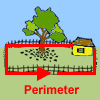 The perimeter of a polygon is the distance around the outside of the polygon. A polygon is 2-dimensional; however, perimeter is 1-dimensional and is measured in linear units. To help us make this distinction, look at our picture of a rectangular backyard. The yard is 2-dimensional: it has a length and a width. The amount of fence needed to enclose the backyard (perimeter) is 1-dimensional. The perimeter of this yard is the distance around the outside of the yard, indicated by the red arrow; It is measured in linear units such as feet or meters.
To find the perimeter of a polygon, take the sum of the length of each side. The polygons below are much smaller than a fenced-in yard. Thus, we use smaller units in our examples, such as centimeters and inches.
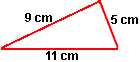 Example 1: Find the perimeter of a triangle with sides measuring 5 centimeters, 9 centimeters and 11 centimeters.
Solution: P = 5 cm + 9 cm + 11 cm = 25 cm
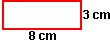 Example 2: A rectangle has a length of 8 centimeters and a width of 3 centimeters. Find the perimeter.
Solution 1: P = 8 cm + 8cm + 3 cm + 3 cm = 22 cm
Solution 2: P = 2(8 cm) + 2(3 cm) = 16 cm + 6 cm = 22 cm
In Example 2, the second solution is more commonly used. In fact, in mathematics, we commonly use the following formula for perimeter of a rectangle:
 where
where  is the perimeter,
  is the length and
  is the width.
In the next few examples, we will find the perimeter of other polygons.
 Example 3: Find the perimeter of a square with each side measuring 2 inches.
Solution:  = 2 in + 2 in + 2 in + 2 in = 8 in
 Example 4: Find the perimeter of an equilateral triangle with each side measuring 4 centimeters.
Solution: = 4 cm + 4 cm + 4 cm = 12 cm
A square and an equilateral triangle are both examples of regular polygons. Another method for finding the perimeter of a regular polygon is to multiply the number of sides by the length of one side. Let's revisit Examples 3 and 4 using this second method.
Example 3: Find the perimeter of a square with each side measuring 2 inches.
Solution: This regular polygon has 4 sides, each with a length of 2 inches. Thus we get:
= 4(2 in) = 8 in
Example 4: Find the perimeter of an equilateral triangle with each side measuring 4 centimeters.
Solution: This regular polygon has 3 sides, each with a length of 4 centimeters. Thus we get:
= 3(4 cm) = 12 cm
 Example 5: Find the perimeter of a regular pentagon with each side measuring 3 inches.
Solution: = 5(3 in) = 15 in
 Example 6: The perimeter of a regular hexagon is 18 centimeters. How long is one side?
Solution: = 18 cm
Let S represent the length of one side. A regular hexagon has 6 sides, so we can divide the perimeter by 6 to get the length of one side (S).
S = 18 cm ÷ 6
S = 3 cm


0 Reviews
Your rating